
Inside: Unschooling high school in a high regulation state can feel so intimidating, but it is totally doable! These tips will help you look at the whole four year picture, translate your child’s natural learning into formal high school credits and most of all, enjoy the high school journey.
Two years ago, I started thinking about unschooling high school, and to be completely honest, I freaked the heck out.
We live in what is considered a high regulation state with subject credit requirements, so I thought I needed to step up my unschooling game. Surely we needed to come up with a structured plan ASAP if we were going to successfully meet all of the credit requirements for homeschooling high school in Pennsylvania.
Needless to say, my oldest did not respond well to me going from a formerly chill unschooling parent to “you’re going to be in high school next year and we need a plan right now!” uptight homeschool parent. Sigh.
Our oldest children endure so much being the guinea pigs, don’t they? Thankfully, at least their younger siblings benefit from the lessons we learn by doing the wrong thing in parenting.
I now know that freaking out was completely unnecessary. Unschooling high school does not need to look all that different from unschooling the younger years.
A bit more is required from you, the parent, to properly document high school learning and give your child what they need to step into their future, but it’s not as intimidating as it seems.
Here’s how we’re approaching unschooling high school in Pennsylvania – a “high regulation” state.
Related: Unschooling in Pennsylvania – An Unofficial Guide (You CAN Do This)
Unschooling High School in a High Regulation State: 7 Tips to Help Put Your Mind at Ease
THIS POST PROBABLY CONTAINS AFFILIATE LINKS. AS AN AMAZON ASSOCIATE, I EARN FROM QUALIFYING PURCHASES. YOU CAN READ OUR FULL DISCLOSURE POLICY HERE.
My disastrous freak out – which led to one month of trying to do extra work I thought we needed to do to meet the requirements – backfired so spectacularly that I desperately reached out to my online friend and fellow unschooling parent Marta.
Former teacher and author of the unschooling memoir 18: An Unschooling Experience, she had already graduated a couple of unschooled kids, and they were thriving. I knew she had the wisdom I needed.
After one phone call with her, I was in a much better place!
I regrouped and started over, in a sense. We went back to the unschooling basics: following their interests, while stepping up our documentation so that I could accurately create a high school transcript.
Here are my top seven tips after unschooling high school for the past two years*.
*Disclaimer: This post is in no way legal advice. You need to read your own state’s homeschool laws and decide for yourself how to best meet those requirements.
You Might Also Like: 7 Tips for Unschooling WITH Anxiety (When Deschooling Isn’t Enough)
1. Require your teen to keep track of their learning, and come up with a system for documentation.
My oldest uses the notepad app on her phone to keep track of her learning by the month.
Much of her learning comes from Youtube (you can learn anything on Youtube!), so she keeps track of the subjects of videos she watches, including any Crash Courses she takes. She also records activities and any conversations we have that might be relevant, etc.
At the end of each month, we meet to go over the list. She sends it to me for my records, and I keep it all in one document, ready to analyze later.
We have a lot of PDA in our home (pathological demand avoidance), so I rarely use words like “require”. But in this case, it’s very much a “if you don’t do this, we cannot keep homeschooling” situation, as I wouldn’t be able to properly document without it and my kiddos with PDA get that.
Related: Low-Demand Parenting Made Parenting Joyful Again – Here Are 7 Demands We Dropped
2. Your primary job is to analyze your child’s organic learning to see how it can meet the law’s requirements, not the other way around.
Every child is different. My oldest is an artist at heart and seems allergic to anything academic.
That personality type means it takes a little more work for me to categorize her learning and fit it into the schoolish boxes transcripts require, but that’s what I signed up for when I decided to be an unschooling parent.
My upcoming freshman, on the other hand, seems to thrive in the academic world!
They are currently taking high school level classes at our homeschool co-op (classes like Intro to World Religions, Social Movements and Media Studies) and are steadily working through Kahn Academy high school level math courses on their own, with occasional support from my Civil Engineer husband as needed. They want to attend college, do dual enrollment classes, take the SATs, the whole academic nine yards.
Documentation is SO much easier on my end for my second unschooled child because their interests naturally fit into schoolish boxes.
But just because creating a transcript for my oldest’s learning is harder, doesn’t mean it’s not doable. It just takes a little more work to translate that self-directed learning into “school speak”.
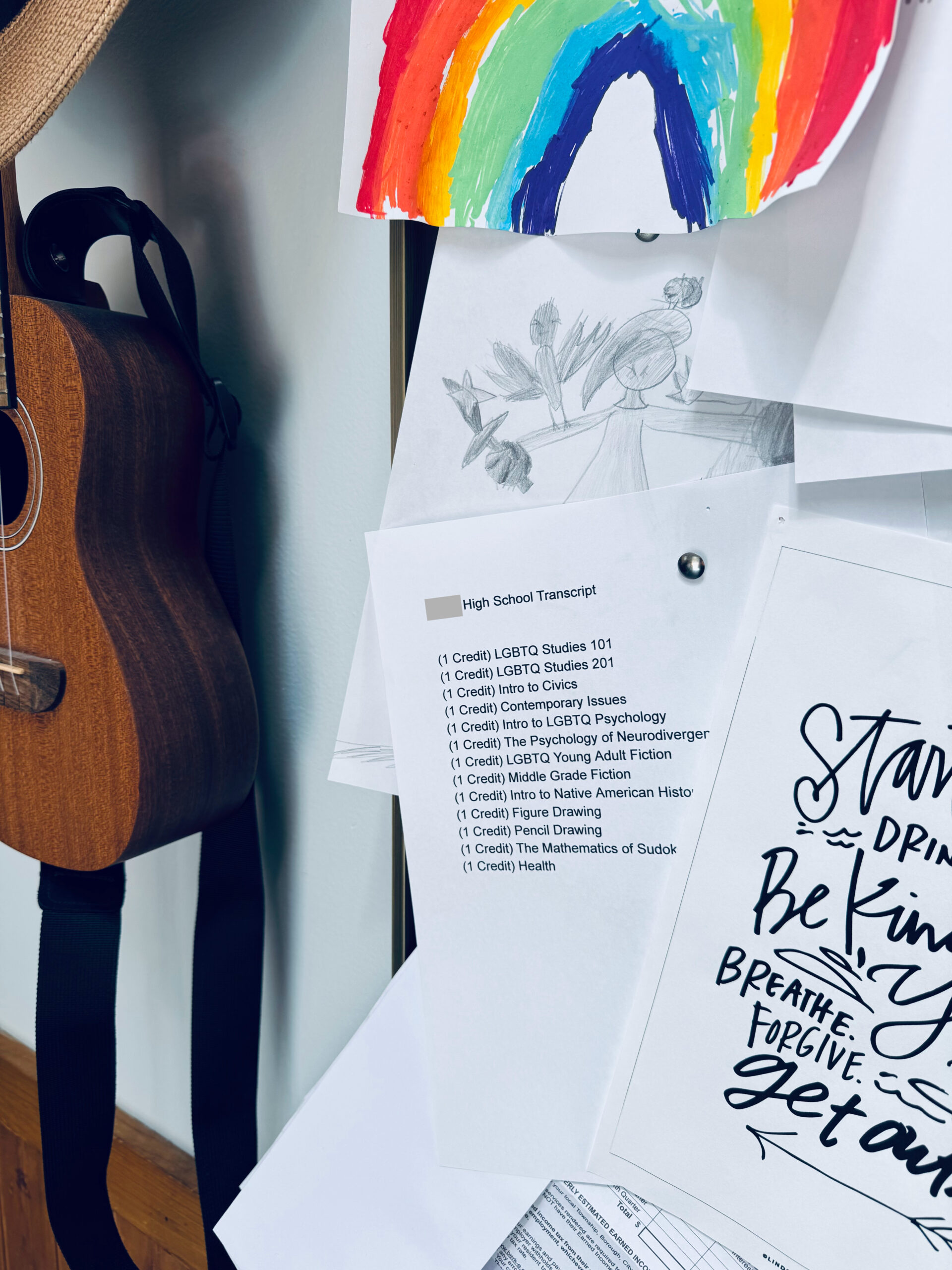
Here are a few examples of her current high school credits…
- Introduction to Native American History (Social Studies)
- Health (Physical Education)
- LGBTQ Studies (Social Studies)
- Intro to LGBTQ+ Psychology (Science)
- LGBTQ Young Adult Fiction (English)
- The Mathematics of Sudoku (1 Math Credit)
- Figure Drawing (1 Humanities Credit)
Her biggest struggle will likely be math credits, whereas her sibling’s biggest struggle will likely be English credits.
3. There really is plenty of time to fill in transcript gaps.

The biggest thing I got out of my phone call with Marta was that you have four full years to meet your state’s high school requirements. That’s plenty of time, and it doesn’t need to be linear!
If you have a slower to launch, less academic kiddo, you can take it slow the first few years. Record their self-directed learning through the end of their junior year, then see what’s missing.
Go over it with your child and show them the “gaps”. Discuss collaboratively how you can meet your state’s requirements.
For example, I imagine with my oldest that will look like some kind of Consumer Math credit her senior year, along with some kind of “high school math overview” or “practical mathematics) credit to cover algebra and geometry basics, as used in real life.
This is why knowing the homeschool law for your state is so important! For secondary education, PA homeschool law requires courses in “mathematics, to include general mathematics, algebra and geometry”.
Nowhere does it say they need a full credit in Algebra or a full credit in geometry. For the traditional math averse unschooler, an Applied Mathematics credit where they learn how to use Algebra and geometry in real life will likely suffice.
Finally, fine tune your child’s transcript – course titles, credits, etc – to their post-high school goals. The transcript for the unschooler who wants to go to college will likely look different (more in depth perhaps?) than the unschooler who wants to go straight into the workforce.
4. Get any relevant neurodivergent assessments in middle school, so they can get accommodations for standardized testing if necessary.
I’ve met a lot of unschooling parents who don’t think that diagnoses for neurodivergence are necessary. You unschool, accommodate, and stay outside the system for a reason, so why bother?
I learned the hard way that just because you unschool doesn’t mean your kids won’t struggle because of their neurodivergence.
We have a cornucopia of neurodivergence in our house! Having diagnoses helped get the support we needed, including therapy, medication and secondary insurance.
Strong Opinion: Having diagnoses in place between ages 11-13 will help them understand how their brains work, why they potentially feel different than their peers or the neurotypical world, and set them up for success in crafting an adult life that fits their unique wiring.
Especially for academic testing like the SAT or ACT, you need a diagnosis in place farther in advance (more than a year, two is better) in order to get accommodations such as extra time or a quiet, separate space. If you get a diagnosis too close to the test, it can look like you’re trying to game the system.
You are obviously free to make choices for your own unschooled kids, but if I could go back, I would have gotten assessments and diagnoses for my older neurodivergent kids sooner, likely around age 11. I plan to be proactive for my younger children and seek assessments earlier.
Because neurodivergence is genetic, I decided to get assessed last year as well, and I discovered at almost 40 that I have both autism and ADHD. I wish I’d known sooner! So much of my life makes sense now, and I want my kids to have that knowledge earlier than I did.
5. What constitutes a “credit” is subjective. Read and know the homeschool law in your state.
Part of my initial unease about high school came after reading a friend’s post about unschooling high school. I love the content, but she took the idea of how many hours makes a credit quite literally based on academic standards.
After talking with Marta and researching how other unschoolers approach counting credits, I came up with my own philosophy/approach.
I personally think hours of study doesn’t always equal mastery. For example, I’ve seen firsthand how a child can learn all of elementary math in very little time when motivated to do so. It takes nowhere near the amount of hours schools spend teaching elementary math throughout grades 1-6.
If a teen can learn a subject in less time, why should they be penalized with less than a full credit?
We love Crash Course on Youtube, where subjects are condensed to hit the key points in less time – perfect for ADHD brains! Just because you could go to school and spend more hours on a subject doesn’t necessarily mean more mastery or more information is retained.
If you feel like the course was more of an overview (for instance, 25 Crash Course videos instead of 50), you could still assign one credit, but change the title to “Introduction to XYZ subject”.
Sometimes (but not always) less is more, and in my personal opinion, credits should reflect that.
You Might Also Like: Unschooling Ideas for 2025-2026 10th, 8th, 6th, 4th and 1st
6. You decide how you want to handle assigning grades.
I was a straight A student with an above 4.0 GPA, the valedictorian of my high school class.
Those grades in no way prepared me for a college environment where I had a rude awakening about the differences between college and high school grading systems. And those grades in no way prepared me for the “real world”.
One grown unschooler I follow on social media described her own grade-free high school experience. This unschooler wrote their own transcript describing the totality of their high school learning, and it was practically a book (11,000 words, I think?). They included zero grades.
They went on to apply to a college with the same “no grades” educational philosophy. A no grades high school and undergraduate experience didn’t prevent them from later getting accepted into an Ivy League graduate school program.
When they finally experienced an environment where grades were a thing, they didn’t find grades helpful. In fact, grades seemed detrimental to learning. It seemed like all the other students cared about were their grades, not learning for its own sake.
I tell you this story to emphasize that whether or not you assign grades is completely up to you, and that choice isn’t the end all be all for your child’s post high school success. How you choose to assign grades (or not assign them) should align with your own educational philosophy.
Some unschooling parents assign grades collaboratively with their child based on what grade they feel they deserve. Others assign mostly As because their child is following their interests and learning what they want to learn, and their retention reflects that (though sometimes, it’s Cs for the stuff they’re doing to meet their state’s requirements).
If you choose not to assign grades, you may want to include an explanation in their high school transcript of the grade free philosophy. Or not. So much depends on what your child wants to do after high school, and what kind of documentation they will need to pursue their post high school goals.
If you’re at the start of unschooling high school, give some thought to your own beliefs around grades, so you have an idea of how you want to approach them.
7. Every unschooled teen will launch at a different pace.
Once, my mom asked me about my “launch plan”. At the time, I was super anxious, and I didn’t really have one. Now I know that I don’t need a cookie cutter launch plan because every child is different.
My oldest two children are night and day. One wants nothing to do with talking about the future. The other is practically itching to spread their wings and get the heck out of here.
Neither one is right or wrong. They’re just different. And different is A-ok.
If your child doesn’t want to talk about the future right now, that’s ok! If they need to live completely in the present, day by day, week by week, that’s fine. Especially if they aren’t interested in college right now, those aren’t conversations that need to be pushed until the spring of their senior year.
If you have a child who is itching to launch, sit down and make a plan. Help them test and develop the best tools for how they’re wired to accomplish what they want to accomplish.
Current parenting culture is very fear driven. It tells us that if we don’t push and prod our kids, they will never launch and will just want to live in their parent’s basement forever, mooching off the adults.
Personally, I believe that if you’ve been practicing respectful parenting and unschooling for years, the likelihood of that happening is very low. Time and again, I’ve heard from unschooling parents with older teens that things can change overnight. One day, they wake up and decide that they need XYZ to reach their goals, and they go out and figure out how to do just that.
You don’t need to push and prod. Follow their lead and work WITH them. Support them and help them find the resources they need to accomplish their goals.
Trust that when you stay connected and work collaboratively, they WILL launch in their own time and in their own ways.
There is whole other conversation to be had about how debilitating late stage capitalism is to the next generation of Americans, and I don’t blame them at all for being cynical. But we’ll have that conversation another time.
Final Note: You, the Homeschooling Parent, Give Your Child a High School Diploma
I can’t even begin to count how many parents in unschooling groups do not realize that they are the ones to give their child a high school diploma.
Will they need it? Maybe, maybe not. Should they have it just in case? 100%.
Your job as an unschooling parent is to help your child succeed. Issuing them a high school diploma is one part of that. Writing them a transcript is another.
Even if they have no college ambitions at the moment, they might one day. And they’ll need at least a transcript for that, if not a diploma.
Side Note: In Pennsylvania, you can opt to have your homeschool evaluator sign your child’s transcript. We will likely go this route.
For Unschooled Teens, The Message “We’ll Figure It Out Together” Goes a Long Way
A few months ago, I went to a zoom call about unschooling teens hosted by Missy Willis from Let ’em Go Barefoot and Erin from Ever Learning. It was a great discussion and such a safe space to share thoughts and concerns.
My biggest takeaway? The mindset I need to communicate as a parent of unschooled teens: “We’ll figure it out together. “
It’s what we need to say to our kids on repeat. And we need to believe that it really IS possible to figure anything out.
They want to become an electrician? We can figure out what they’ll need to get into an electrician program.
They want to become a writer? We’ll help them figure out a path, even if they’ve never written an essay or a story (unlikely as this scenario is – unschooled kids almost always show their leanings throughout childhood).
They want to get into college? We’ll get them a tutor for the SATs and make sure they have the prerequisites they need and the tools to succeed.
That quiet confidence that together, we can figure out just about anything is your biggest asset in unschooling.
So kick that fear to the curb and start repeating that phrase until YOU believe it. Because when you believe it and can communicate it with confidence, they’ll believe it, too.
When done well, unschooling high school doesn’t limit them at all. Instead, it shapes them and makes them stand out from the crowd in the best possible way.
You don’t need to send them back to school when they hit ninth grade. You can unschool high school. You’ve got this!
Read Next: What Is Unschooling? Defining The Most Misunderstood Homeschool Style
Drop any questions about unschooling high school in the comments, and I will do my best to answer them. If I don’t know the answer, I’ll find someone who does.

we too are unschooling high school with 2 very opposite personality neurospicy kids💜 but we are in NC with fewer highschool requirements… the older has recently flipped that switch and chosen a college and a degree, so their highschool plans are mostly based around the requirements of the state university system, and the younger is leaning toward a very eclectic education like your oldest. I’m actually highly amused by the “copywriting” of translating real life learning I to education-ese💜 it can be a fun game, as long as you are past that initial freak out stage